Homelab Network v2 (HNv2)
Homelab Network v2 is a multi-node Linux environment built to support development, hosting, orchestration, and long-running self-managed services. Rather than treating everything as a single-machine setup, the system is organized as a personal infrastructure platform with distinct responsibilities assigned to each node.
Overview
HNv2 is the backbone of my personal infrastructure work. It provides a stable environment for software development, self-hosted web services, system testing, and tools that need to remain available beyond a single workstation session.
In practice, the system functions as both a working homelab and a long-term platform for experimentation. It supports day-to-day development and hosting work while leaving room for iterative improvements in deployment, service boundaries, and remote administration.
Core Architecture
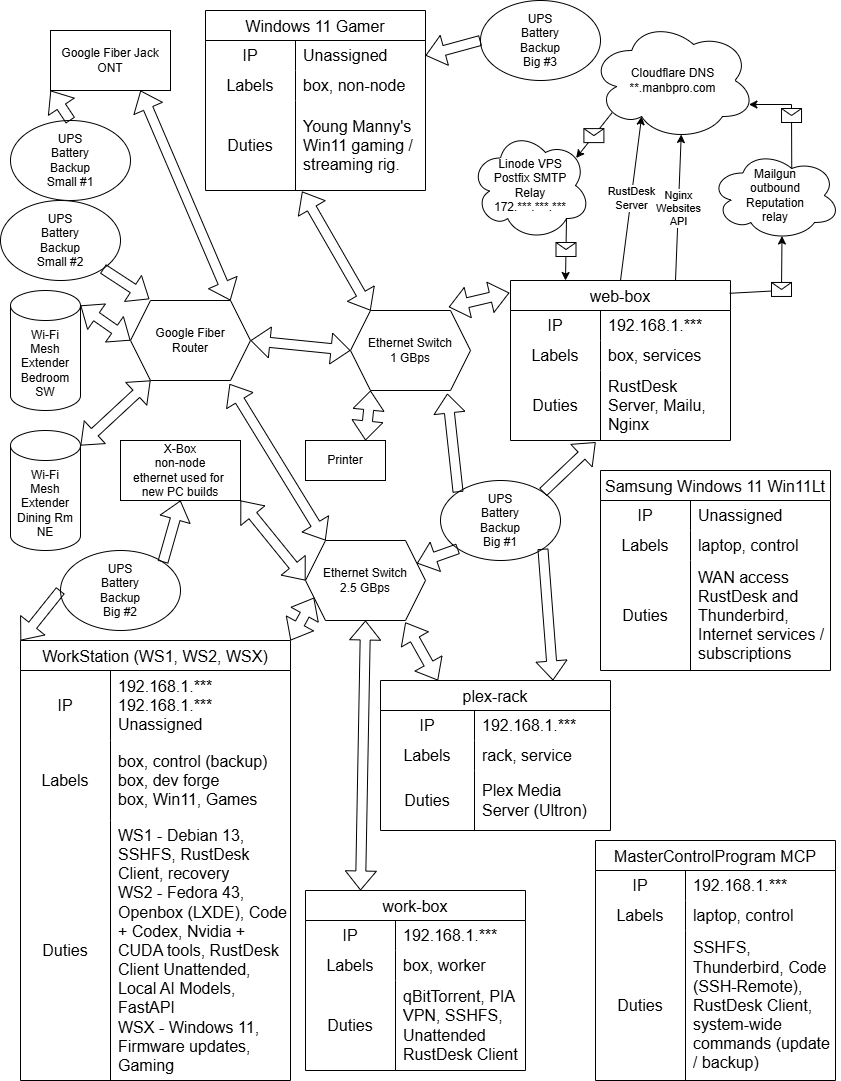
MCP acts as the control plane for the environment. It anchors the network from an administration and orchestration perspective, providing a consistent place for management, coordination, and core control tasks instead of scattering them across multiple machines.
WS2 is the primary development environment. It is where tooling, coding workflows, and AI-related experimentation come together, making it the main system for building, testing, and remotely continuing development work across the network.
web-box handles public-facing services. It is positioned to expose external applications and infrastructure components such as reverse proxying, mail services, and future API endpoints while keeping internet-facing workloads separated from the rest of the lab.
Supporting Systems
Additional nodes including plex-rack, WS1, work-box, and external services such as Linode play supporting roles across storage, media, utility tasks, development flexibility, and remote connectivity. plex-rack in particular required integrating custom hardware into a mixed enterprise and consumer storage setup, but these systems remain secondary to the primary responsibilities held by MCP, WS2, and web-box.
Engineering Focus
A major part of the project is making effective use of repurposed hardware. That means working within the limits of mixed-generation systems and turning salvaged equipment into a dependable platform through careful configuration rather than unnecessary overbuilding.
The engineering challenge is less about any single service and more about system integration: aligning development workflows, public services, storage roles, and remote access into one environment that behaves predictably across nodes. That included building WS2 as a custom Openbox-based development environment with unattended remote access, and doing the additional hardening and operational work needed to keep web-box stable for public services.
Security and stability remain central throughout the design. Segmentation of roles, hardening decisions, and conservative operational choices are all aimed at keeping the network useful day to day while reducing avoidable failure points.
Diagram
Looking Ahead
HNv2 is intended to keep evolving as a durable foundation for development, hosted services, and future expansion, with changes driven by reliability and practical capability rather than novelty.